I really am quite over the holidays. Holidays for me, like many students, entails working, trying to save money for the next semester. Of course, I work primarily for my parents, so I go from very little family exposure to all family, all day! It really is a little too much!
I'm busily trying to craft the perfect timetable for the next semester and, as I am unable to undertake the legal clinic I desperately wanted to do, have decided I will take the family law elective. My decision to do so has shocked some of my friends and family as I SWORE black and blue that I would definitely not be doing the subject. Well times have changed... I'm now a fourth year student with a history of failing behind me and little experience. While I have a journal article published (oh yeah, that's some news I forgot to relay), I'm not so sure that it is enough to secure me a job. With divorce rates as high as ever, I feel it would be amiss of me to fail to even consider undertaking family law. When I look at law firms, so many of them work in family law that having knowledge of the area would be beneficial.
I remember talking to older law students while in my first year and they told me how sad family law is and how many of them were in tears week by week. I don't think this will be an issue for me, but it has been a reason I have avoided it. Right now, there is one thing that is turning me off the subject - the lecture is at 8am! I haven't had an 8am class since my first year and now that I live off-campus, I'll have to leave at around 7am to make it on time! I may live 15 minutes away, but the traffic early morning is a nightmare!
While I'm definitely over the holidays, I am enjoying my new laptop. I purchased an 11" MacBook Air to replace my 13" MacBook Pro that died during exams. It's great, but I'm also looking forward to the release of an updated iMac from Apple. I worked out that buying an Air as well as an iMac will ultimately cost less and get me a great set-up. I can't wait to have a desktop!
This also means a significant change for me, going back to taking notes on my computer. I haven't done so for some time, but with a new (and tiny) computer it's not only an option, but the best option. Although the 11" MBA has a low-ish battery life, it should be more than enough for my needs. I've also gotten in the habit of always carrying a charger with me anyway, after having a dodgy laptop battery in my old computer.
Oh and yes, I have put my laptop in an envelope. Haven't you?
On that note, I'm off to spend some time with my family.
Wednesday, July 11, 2012

Sunday, July 1, 2012
Sleep: Is it really that important?
I've never been the type of person that love to sleep all day. As a child I would make pillow forts that were solid enough to hide the light from my torch, allowing me to read late into the night. As I got older, I would wake up during the night and, unable to get back to sleep, would surf the internet. I eventually kicked that habit, instead staying up into the early hours before sleeping. I have continued to find, however, that if I go to bed at what is considered a 'decent' hour I wake up at least once during the night. I've always thought this to be 'abnormal' and assumed I had partial insomnia, but I'm starting to think that this is actually a more natural way of sleeping.
I've always been told that at night we sleep and our ancestors did the same because there was nothing else to do once it was dark. I've done some basic research and found that, while our ancestors did go to bed soon after dark, they did not sleep through the night, rather for around four hours before waking. They would talk and what not for a few hours before sleeping again for some time. From what I have read, the change in sleep patterns is attributed to the industrial revolution and widespread use of electricity. As more people had access to lighting, it no longer became necessary to sleep as soon as night fell and people began to stay up later, resulting in monophasic sleep.
I grew up in an industrial town, with many of my friend's parents doing shift-work. As a result, I was always aware of alternative sleep patterns, but never anything more sophisticated than sleeping during the day instead of at night.
My first encounter with drastically different sleep patterns was the 28-hour-day:

I loved the sound of it, and it even seemed fairly practical, but I figured it would result in confusion and disconnect from the real world.
I continued exploring and found polyphasic sleeping. I found a 'popular' form was being awake for four hours and sleeping for 30 minutes, reducing the sleep needed per day and increasing productivity. Not only would this be impractical in so many ways (workplace, uni, socialisation etc) but I am the type of person that takes a lengthy time to fall asleep. If tired enough, I can sleep easily, but I am entirely unwilling to try such a drastic measure.
Biphasic sleep fell into my lap recently and quite unexpectedly. I stopped my research on sleep patterns a year ago and had all-but forgotten my findings. After an afternoon of research, it makes sense. Basically, the idea is that you sleep for three hours (for the super-dedicated), 4.5 hours (for most), or six hours (for others) in the morning. Notice that each number is a derivative of 90 minutes? The average sleep cycle is roughly 90minutes long, though people vary from 60 to 120 minutes. You then get up and go about your day. At some point you have a nap for around 90 minutes (another sleep cycle) and continue your day. The idea is that you can have your cake and eat it too; getting up early does not mean sacrificing late nights! Furthermore, you get more time in your day!
I plan to try 4.5 hours with a 90minute nap as I'm not a huge sleeper. While I'm not starting for a few weeks, my planned sleep pattern will be:
1:00am - 5:30am Sleep
6:00pm - 7:30pm Nap
In an ideal world, my nap would be around 3pm, and most likely will be where my uni classes allow, but reality dictates that it be later on. On two days of the week I will be rushing home from class to nap, hopefully getting it in immediately.
A large part of why I am interested to try this is that many people who have trialled such a sleep pattern have found they are more productive and have more energy. I have heard in the past (though I don't have any references to support this) that it is possible that we get too much sleep. I believe that this is probably very likely, based on the largely sedentary nature of the 21st century. We eat much more than we should for the energy we expend and it only makes sense that we sleep too much as well. It's also cited in many places that sleep is important for learning, so I am interested to see if having a nap in the afternoon helps with the learning process.
While there is plenty of scientific information out there, I think the main reason I am interested in biphasic sleep is that I'm a night owl and love staying up late, but see the practical benefits of being an early riser. I love knowing that few people are still awake and the imagery of writing or reading late into the night. For years as a child I woke up at 3:30am (and then more like 5:30am as I worked out I could stay up 'late') and loved having my day underway early. I love going to the gym in the morning, but don't like waiting until the traffic dies down. While I don't need to be anywhere early, I like to be, but late nights aren't something that I am sure I want to sacrifice.
Unfortunately, many of the people I have found online who have documented their biphasic sleep patterns seem to have reverted to monophasic sleeping after either a short period or an extended period. I know that it probably is not practical in the long term, but I can see the value of it for me at this stage of my life. I will be travelling overseas later in the year and know that I woun't be able to continue sleeping in this way, but during semesters, I see the value. At least I can say that I tried it!
I've always been told that at night we sleep and our ancestors did the same because there was nothing else to do once it was dark. I've done some basic research and found that, while our ancestors did go to bed soon after dark, they did not sleep through the night, rather for around four hours before waking. They would talk and what not for a few hours before sleeping again for some time. From what I have read, the change in sleep patterns is attributed to the industrial revolution and widespread use of electricity. As more people had access to lighting, it no longer became necessary to sleep as soon as night fell and people began to stay up later, resulting in monophasic sleep.
I grew up in an industrial town, with many of my friend's parents doing shift-work. As a result, I was always aware of alternative sleep patterns, but never anything more sophisticated than sleeping during the day instead of at night.
My first encounter with drastically different sleep patterns was the 28-hour-day:
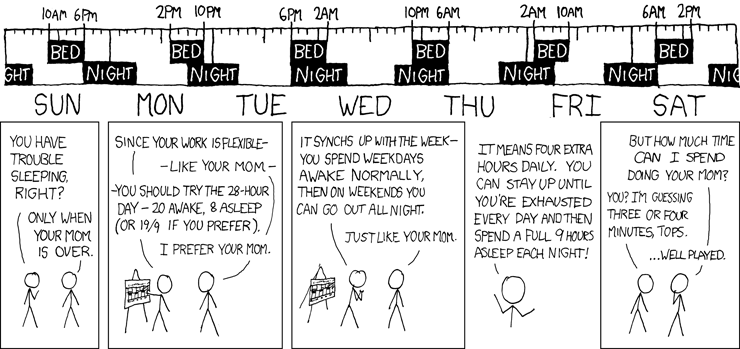
I loved the sound of it, and it even seemed fairly practical, but I figured it would result in confusion and disconnect from the real world.
I continued exploring and found polyphasic sleeping. I found a 'popular' form was being awake for four hours and sleeping for 30 minutes, reducing the sleep needed per day and increasing productivity. Not only would this be impractical in so many ways (workplace, uni, socialisation etc) but I am the type of person that takes a lengthy time to fall asleep. If tired enough, I can sleep easily, but I am entirely unwilling to try such a drastic measure.
Biphasic sleep fell into my lap recently and quite unexpectedly. I stopped my research on sleep patterns a year ago and had all-but forgotten my findings. After an afternoon of research, it makes sense. Basically, the idea is that you sleep for three hours (for the super-dedicated), 4.5 hours (for most), or six hours (for others) in the morning. Notice that each number is a derivative of 90 minutes? The average sleep cycle is roughly 90minutes long, though people vary from 60 to 120 minutes. You then get up and go about your day. At some point you have a nap for around 90 minutes (another sleep cycle) and continue your day. The idea is that you can have your cake and eat it too; getting up early does not mean sacrificing late nights! Furthermore, you get more time in your day!
I plan to try 4.5 hours with a 90minute nap as I'm not a huge sleeper. While I'm not starting for a few weeks, my planned sleep pattern will be:
1:00am - 5:30am Sleep
6:00pm - 7:30pm Nap
In an ideal world, my nap would be around 3pm, and most likely will be where my uni classes allow, but reality dictates that it be later on. On two days of the week I will be rushing home from class to nap, hopefully getting it in immediately.
A large part of why I am interested to try this is that many people who have trialled such a sleep pattern have found they are more productive and have more energy. I have heard in the past (though I don't have any references to support this) that it is possible that we get too much sleep. I believe that this is probably very likely, based on the largely sedentary nature of the 21st century. We eat much more than we should for the energy we expend and it only makes sense that we sleep too much as well. It's also cited in many places that sleep is important for learning, so I am interested to see if having a nap in the afternoon helps with the learning process.
While there is plenty of scientific information out there, I think the main reason I am interested in biphasic sleep is that I'm a night owl and love staying up late, but see the practical benefits of being an early riser. I love knowing that few people are still awake and the imagery of writing or reading late into the night. For years as a child I woke up at 3:30am (and then more like 5:30am as I worked out I could stay up 'late') and loved having my day underway early. I love going to the gym in the morning, but don't like waiting until the traffic dies down. While I don't need to be anywhere early, I like to be, but late nights aren't something that I am sure I want to sacrifice.
Unfortunately, many of the people I have found online who have documented their biphasic sleep patterns seem to have reverted to monophasic sleeping after either a short period or an extended period. I know that it probably is not practical in the long term, but I can see the value of it for me at this stage of my life. I will be travelling overseas later in the year and know that I woun't be able to continue sleeping in this way, but during semesters, I see the value. At least I can say that I tried it!
Sunday, June 24, 2012
ugh... practice makes perfect?
I know I have been a fairly prolific poster lately but I suppose exams have had me thinking about relevant things more than usual. After a weekend of heavy studying, I took a past exam and had a look at it.
Admittedly, I rely on past exams for practice much less than many of my fellow students. While it does feel good to practice, I hate doing questions when I don't have answers or suggested approaches that I can work with.
Early on in my degree I loved using practice exams and used them extensively in my exam preparation. When I failed my first subject, I was confused - I had been doing past exams for weeks without any trouble, how could I have failed? I then realised that being able to answer a question easily does not ensure the answer is correct and, without an answer to check, can just lead to a false sense of security.
You can avoid this by working with other people and comparing answers, but this approach doesn't work for me. I know that I work better at my own pace rather than working with other people, at least the majority of time.
After a few more exams, I realised it was important to do practice questions and ended up finding a series of books that had exam-type questions with answer structures. I've continued to use these when possible to avoid any risk of being blind-sighted in an exam.
If only law exams consisted of more straightforward questions, with clear answers! There is nothing like going into an exam and knowing the way a particular lecturer structures their questions. I'm slowly trying to make sure I work through a few past exam questions for each exam, but they are often so dry and boring that I'd prefer to work on anything else. Until today...
While I had already had a brief look at one of the past exams for the subject I am yet to sit, I only sat down to have a good look at it tonight. It turns out one of the questions is essentially the plot of The Hangover.
The question continues, including Alan's purchase of vintage Jaegermeister, Phil's excessive gambling, Alan's grabbing of the wrong satchel and Mr Chow's chips, illegal parking and the theft of a tiger from Mr Tyson's mansion... It is a huge question with so many issues and a recommended time of 80 minutes to work through the question. Of course, it's so hilarious that I can't help but laugh whenever I try to work through the problem. While it is a different examiner this year, I can't help but be slightly worried that something similar will appear on this year's paper and wonder what I will do if this happens!
Going back further, I found a problem eerily similar to Grey's Anatomy, based at 'Brisbane Grace Hospital'. No joke! Ah I love when lecturers engage with pop culture!
Admittedly, I rely on past exams for practice much less than many of my fellow students. While it does feel good to practice, I hate doing questions when I don't have answers or suggested approaches that I can work with.
Early on in my degree I loved using practice exams and used them extensively in my exam preparation. When I failed my first subject, I was confused - I had been doing past exams for weeks without any trouble, how could I have failed? I then realised that being able to answer a question easily does not ensure the answer is correct and, without an answer to check, can just lead to a false sense of security.
You can avoid this by working with other people and comparing answers, but this approach doesn't work for me. I know that I work better at my own pace rather than working with other people, at least the majority of time.
After a few more exams, I realised it was important to do practice questions and ended up finding a series of books that had exam-type questions with answer structures. I've continued to use these when possible to avoid any risk of being blind-sighted in an exam.
If only law exams consisted of more straightforward questions, with clear answers! There is nothing like going into an exam and knowing the way a particular lecturer structures their questions. I'm slowly trying to make sure I work through a few past exam questions for each exam, but they are often so dry and boring that I'd prefer to work on anything else. Until today...
While I had already had a brief look at one of the past exams for the subject I am yet to sit, I only sat down to have a good look at it tonight. It turns out one of the questions is essentially the plot of The Hangover.
Phil, Stu, Alan and Doug are four friends who live in Brisbane... The four have made a booking at Caesar's Palace, a well known hotel in the heart of the Gold Coast. (For clarification, this is not the real Caesar's palace - Caesar never lived here.)...
The question continues, including Alan's purchase of vintage Jaegermeister, Phil's excessive gambling, Alan's grabbing of the wrong satchel and Mr Chow's chips, illegal parking and the theft of a tiger from Mr Tyson's mansion... It is a huge question with so many issues and a recommended time of 80 minutes to work through the question. Of course, it's so hilarious that I can't help but laugh whenever I try to work through the problem. While it is a different examiner this year, I can't help but be slightly worried that something similar will appear on this year's paper and wonder what I will do if this happens!
Going back further, I found a problem eerily similar to Grey's Anatomy, based at 'Brisbane Grace Hospital'. No joke! Ah I love when lecturers engage with pop culture!
Rest in Peace Highway Unicorn
So in typical Obiter Girl fashion, my ailing computer finally succumbed to death in the midst of exams. While I had most of my important documents backed up, there is no substitute for a working computer! As my laptop had been on it's last legs for some time, I had planned to upgrade to a new laptop at this point, although I was hoping it wouldn't be out of necessity. With four and a half years under it's belt, my poor laptop (known affectionately as Highway Unicorn) was well into old age and I had originally hoped that she would live until my eventual graduation. Apparently not.
Of course, in typical Obiter Girl fashion, my laptop died only 6 days after Apple's latest announcement, meaning there were long waiting lists for the gorgeous new Retina Macbook Pros. Of course!
In the end, I came up with a solution that means I will have the portability of a laptop (without having to wait a month or so!) and the power of a desktop! I've acquired an 11" Macbook Air and will be using it while away from home, while using an iMac at home... if I ever get around to getting one! Bonus: It works out cheaper than the new Retina Macbook Pros!
I'm ever so glad to be back in this century! At the same time that my computer was off-limits, my phone was being disobedient and failing to work. Of course. Luckily, I had my iPad so I wasn't entirely cut off from the world, but I was very close
Of course, in typical Obiter Girl fashion, my laptop died only 6 days after Apple's latest announcement, meaning there were long waiting lists for the gorgeous new Retina Macbook Pros. Of course!
In the end, I came up with a solution that means I will have the portability of a laptop (without having to wait a month or so!) and the power of a desktop! I've acquired an 11" Macbook Air and will be using it while away from home, while using an iMac at home... if I ever get around to getting one! Bonus: It works out cheaper than the new Retina Macbook Pros!
I'm ever so glad to be back in this century! At the same time that my computer was off-limits, my phone was being disobedient and failing to work. Of course. Luckily, I had my iPad so I wasn't entirely cut off from the world, but I was very close
Sunday, June 17, 2012
the hand of facebook
Last year I took a few months off Facebook. It wasn't really intentional, at least not at first, but I later realised that avoiding the time-sucking site was amazing. I felt so clear in the head and I seemed to have much more time. In the end, I found existing in without the site was difficult, with many people only using the site as their only way to communicate with others. I gave up and returned to the site, but spend much less time on the site than I have previously.
So when I found myself looking for distractions while trying to study, I decided facebook had to go! Unlike the past, I now have an iPad and that has been my main mode of using the site. My password has been a long string of characters randomly generated online for some time and I haven't made an attempt to memorise the password. Instead I've been breaking the one rule of passwords - I've had it written down.
Unable to remember my password, I knew locking myself out would be relatively easy. I didn't need a friend to change my password and just needed to 'lose' the password. I sent a facebook message to a friend, asking them to hold onto the password and gave it on a piece of paper with a set of instructions to a housemate. I instructed both of them that I would argue that I needed facebook to check an answer with a friend but they were not to give me the password unless I articulated what I needed to ask. Simply stating I needed to check something for Trusts would be insufficient, but if I was to say I needed to ask about exceptions to perpetuity periods I would be able to get the password back. They both laughed, thinking I was going overboard. I just wanted to cover all bases.
Of course, my plan relied on one thing - logging out. I logged out on my phone and ipad immediately but, as I've realised now, never actually logged out on my computer. I also never threw out the piece of paper with the password on it and it remains in it's place on my wall. What I find fascinating is that I never tried to go to facebook. I haven't wanted to and I certainly don't miss it. I feel exactly like I did last year when I took my hiatus from the social networking site.
Even though I thought I was unable to get on the site for the majority of the past 3 weeks, I would like to think that my lack of attempts is evidence of my superior self-control. The fact that I attempted to lock myself out of the site is irrelevant in my mind, as I've glanced around the library, looking down on the many people who aren't studying but facebooking instead. Yeah, I know it's hypocritical of me, but I feel so much better than everyone else here. While I have found other ways to waste my time, facebok hasn't even crossed my mind and I've gotten more work done than I usually would.
While it is rather extreme, I definitely recommend you think about getting ride of facebook when you need to get work done! You don't have to change your password to avoid the site as there are many ways to block you from the site for shorter periods of time. The only downside is that you will have too much time to study!
So when I found myself looking for distractions while trying to study, I decided facebook had to go! Unlike the past, I now have an iPad and that has been my main mode of using the site. My password has been a long string of characters randomly generated online for some time and I haven't made an attempt to memorise the password. Instead I've been breaking the one rule of passwords - I've had it written down.
Unable to remember my password, I knew locking myself out would be relatively easy. I didn't need a friend to change my password and just needed to 'lose' the password. I sent a facebook message to a friend, asking them to hold onto the password and gave it on a piece of paper with a set of instructions to a housemate. I instructed both of them that I would argue that I needed facebook to check an answer with a friend but they were not to give me the password unless I articulated what I needed to ask. Simply stating I needed to check something for Trusts would be insufficient, but if I was to say I needed to ask about exceptions to perpetuity periods I would be able to get the password back. They both laughed, thinking I was going overboard. I just wanted to cover all bases.
Of course, my plan relied on one thing - logging out. I logged out on my phone and ipad immediately but, as I've realised now, never actually logged out on my computer. I also never threw out the piece of paper with the password on it and it remains in it's place on my wall. What I find fascinating is that I never tried to go to facebook. I haven't wanted to and I certainly don't miss it. I feel exactly like I did last year when I took my hiatus from the social networking site.
Even though I thought I was unable to get on the site for the majority of the past 3 weeks, I would like to think that my lack of attempts is evidence of my superior self-control. The fact that I attempted to lock myself out of the site is irrelevant in my mind, as I've glanced around the library, looking down on the many people who aren't studying but facebooking instead. Yeah, I know it's hypocritical of me, but I feel so much better than everyone else here. While I have found other ways to waste my time, facebok hasn't even crossed my mind and I've gotten more work done than I usually would.
While it is rather extreme, I definitely recommend you think about getting ride of facebook when you need to get work done! You don't have to change your password to avoid the site as there are many ways to block you from the site for shorter periods of time. The only downside is that you will have too much time to study!
Saturday, June 16, 2012
the perils of open book
After a fairly successful semester (or at least I think it has been fairly successful) I'm in the midst of exams. I have now decided that I hate open book exams. Why? There are a number of reasons for this hatred, but they are not because I think they are more difficult.
It is no secret to my friends that I regularly wage psychological warfare... on myself. Yes, I'm one of those people who manages to 'psych' myself out about almost every piece of assessment. Having failed subjects previously has definitely added to my fear of failure as I have lived through it. Open book exams seem great - you can use any source you want to answer the questions. Of course, what if you don't bring something and it turns out to be VITALLY important in the exam? What if you see someone using a particular book which you have but have no idea how they are using it? The topics covered in the book don't seem to be on the exam - what do they know that you don't know?
As a result, I have a tendency to go overboard. For my open exam last night I vigorously prepared. It was for Trusts and I had done fairly well on the assignment, needing roughly 20% to pass the subject. I spent much of the week preparing my notes into an easily digestible form, ending up with a hefty 80 pages. I went all out, even including extracts as I had no intention to print out the giant pieces of legislation that we had covered. I then prepared some answer guides that were around 100 pages, leaving my notes almost irrelevant. Of course, these guides were AMAZING and I'm glad I had them.
In the end, I decided that I would print the legislation. My upcoming Property exam is closed book but we are able to take unanotated legislation in, so I figured I needed a copy of the Property Law Act anyway. I have an amazing (by which I mean cheap) laser printer and figured binding isn't too expensive. I was feeling lazy, so I printed out the Trusts Act, Successions Act and Property Law Act in full - one page per page. I couldn't be bothered to work out how to print back to back (I forget every time I do it!) so my Property Law Act is a hefty 300 pages, plus the binding! Didn't think that through.
I also took my textbook and a Equity & Trusts Questions and Answer book. I had so much stuff I could barely carry it all into the exam and was surprised to see how little some people took with them. I have a tendency to go overboard, but I realised that I had reached a new level. I thought back to other exams where I took legislation and realised I very rarely, if ever, actually looked through them or used the tabs. Other people had a few pages of notes and others didn't even bother bringing the textbook! Admittedly, knowing the subject had an open book exam meant I didn't attempt to memorise through the semester, but rather focused on understanding, but still... I had so much in terms of notes!
As students entered the room I saw a number who also had the Q&A book with them. I have had very few open book exams, but have made an attempt to bring a Q&A book whenever I have. I have often found them useful, mainly for working out a good structure and approach, but moreso when I am fairly familiar with the content of the book. This time I spent very little time working on questions from the book. Regardless, when I saw the girl in front pull hers out from the start I was worried. I made an attempt to use the book later on in the exam, but I couldn't. I was worried - why was she using it when I couldn't find something it worked for? Luckily, this didn't bother me for too long as I remembered I had the answer guides with me. I worked through the problems I could using the guides where I could. One of the supervisors seemed fascinated by my bound notes and kept looking at them whenever he passed. Of course, law exams are never a straight forward time when question one addresses a discretionary trust, question two addresses a charitable trust and so on.
Although it has quite possibly happened before, I do not recall ever being told that we are unable to use materials during perusal. I had already had an open book exam earlier in the week for medical law and used my notes extensively in perusal for planning my responses... or at least I think I did! As I said earlier, my attempts in Trusts have been focused on understanding the content and even though I think I have a fairly solid idea of how a trust works, I still like to check where I can. For me this was also the case for Criminal Law, with no exam for the first semester of the subject last year and an open book for the second. I remembered a significant amount on Charitable trusts so tried to use what I knew to plan out one answer, but without my guide I knew I was forgetting valuable information. In hindsight, I should have used the 10 minutes to plan out and begin my answers for the smaller questions. Alas, that was not the case
I'm extremely glad that I'm finished with trusts... at least for a few weeks. I spent so much time working on my notes this week that I have neglected property, to an extent. Even though there are only a few days left, I'm still trying to work through my notes and I'm not sure how much I actually remember. I have been working on my flash cards for a few weeks now so I am fairly certain I have memorized a fair bit about the cases that are relevant, but I still need to remember the contexts! Ahh!
One thing I am glad of is the overlap between property and trusts. While I didn't memorise anything for my trusts exam, I think I can remember the overlapping areas. I think. I hope. I suppose I should probably get back to it!
Good luck to anyone else working through exams right now!
It is no secret to my friends that I regularly wage psychological warfare... on myself. Yes, I'm one of those people who manages to 'psych' myself out about almost every piece of assessment. Having failed subjects previously has definitely added to my fear of failure as I have lived through it. Open book exams seem great - you can use any source you want to answer the questions. Of course, what if you don't bring something and it turns out to be VITALLY important in the exam? What if you see someone using a particular book which you have but have no idea how they are using it? The topics covered in the book don't seem to be on the exam - what do they know that you don't know?
As a result, I have a tendency to go overboard. For my open exam last night I vigorously prepared. It was for Trusts and I had done fairly well on the assignment, needing roughly 20% to pass the subject. I spent much of the week preparing my notes into an easily digestible form, ending up with a hefty 80 pages. I went all out, even including extracts as I had no intention to print out the giant pieces of legislation that we had covered. I then prepared some answer guides that were around 100 pages, leaving my notes almost irrelevant. Of course, these guides were AMAZING and I'm glad I had them.
In the end, I decided that I would print the legislation. My upcoming Property exam is closed book but we are able to take unanotated legislation in, so I figured I needed a copy of the Property Law Act anyway. I have an amazing (by which I mean cheap) laser printer and figured binding isn't too expensive. I was feeling lazy, so I printed out the Trusts Act, Successions Act and Property Law Act in full - one page per page. I couldn't be bothered to work out how to print back to back (I forget every time I do it!) so my Property Law Act is a hefty 300 pages, plus the binding! Didn't think that through.
I also took my textbook and a Equity & Trusts Questions and Answer book. I had so much stuff I could barely carry it all into the exam and was surprised to see how little some people took with them. I have a tendency to go overboard, but I realised that I had reached a new level. I thought back to other exams where I took legislation and realised I very rarely, if ever, actually looked through them or used the tabs. Other people had a few pages of notes and others didn't even bother bringing the textbook! Admittedly, knowing the subject had an open book exam meant I didn't attempt to memorise through the semester, but rather focused on understanding, but still... I had so much in terms of notes!
As students entered the room I saw a number who also had the Q&A book with them. I have had very few open book exams, but have made an attempt to bring a Q&A book whenever I have. I have often found them useful, mainly for working out a good structure and approach, but moreso when I am fairly familiar with the content of the book. This time I spent very little time working on questions from the book. Regardless, when I saw the girl in front pull hers out from the start I was worried. I made an attempt to use the book later on in the exam, but I couldn't. I was worried - why was she using it when I couldn't find something it worked for? Luckily, this didn't bother me for too long as I remembered I had the answer guides with me. I worked through the problems I could using the guides where I could. One of the supervisors seemed fascinated by my bound notes and kept looking at them whenever he passed. Of course, law exams are never a straight forward time when question one addresses a discretionary trust, question two addresses a charitable trust and so on.
Although it has quite possibly happened before, I do not recall ever being told that we are unable to use materials during perusal. I had already had an open book exam earlier in the week for medical law and used my notes extensively in perusal for planning my responses... or at least I think I did! As I said earlier, my attempts in Trusts have been focused on understanding the content and even though I think I have a fairly solid idea of how a trust works, I still like to check where I can. For me this was also the case for Criminal Law, with no exam for the first semester of the subject last year and an open book for the second. I remembered a significant amount on Charitable trusts so tried to use what I knew to plan out one answer, but without my guide I knew I was forgetting valuable information. In hindsight, I should have used the 10 minutes to plan out and begin my answers for the smaller questions. Alas, that was not the case
I'm extremely glad that I'm finished with trusts... at least for a few weeks. I spent so much time working on my notes this week that I have neglected property, to an extent. Even though there are only a few days left, I'm still trying to work through my notes and I'm not sure how much I actually remember. I have been working on my flash cards for a few weeks now so I am fairly certain I have memorized a fair bit about the cases that are relevant, but I still need to remember the contexts! Ahh!
One thing I am glad of is the overlap between property and trusts. While I didn't memorise anything for my trusts exam, I think I can remember the overlapping areas. I think. I hope. I suppose I should probably get back to it!
Good luck to anyone else working through exams right now!
Sunday, June 3, 2012
no one likes revision
So it's SWOTVAC or, as my university 'officially' calls it, 'revision week'. All of a sudden the library, where I get the bulk of my work done, has filled and I struggle to get my usual desk.
My usual desk is perfect - it's not one of the tiny work-desks, all lined up and barely enough room to put my laptop and a textbook, but it's not a wide open section of bench that means everyone else can see what I'm doing. It's also close to a powerpoint, meaning I can actually use my laptop which has a life-span of a whopping 45 minutes. I hate being out in the open where everyone else can see what I'm doing, but I also like to be able to see what others are doing. From my desk I can see if the library is emptying, usually a sign that it is time to leave.
While tempted to work hardcore for the stretch of this week, I know it won't happen. I am still recovering from a large essay for one of my subjects, only now submitted, and am absolutely exhausted. While I know it's better for me to work really hard now, leaving me with more time to actually study in the next few weeks, it won't happen. I'll still be working on my summaries as the exam nears. It happens every time and, to be honest, I'm not sure that I mind.
I know I'm better off if I don't have to work hard on a summary in the days leading to an exam, or that the best way to use my time is to work through problems. The thing is that I have taken this approach before. I have studied all day and all night through SWOTVAC, only to get into the exam and not know anything. I've taken the approach of using problems to study, rather than working on a concise summary. These things don't seem to work for me.
Instead, I relax during SWOTVAC. When I told my mum this, she almost had a heart attack! 'Don't tell me things like that' she said, telling me how sick that thought made her. I tried to explain that by 'relax' I don't mean chilling by a pool (or fireplace) sipping margaritas, rather that I work hard, but use some time to relax. I continue to watch TV occasionally and get sleep if I am tired. I basically approach it like any other week, just minus the classes.
The fact of the matter is, I'm going to get stressed in exam period no matter how prepared I am. I get stressed in exams and once thought it was a healthy level of stress that really helped me. Through my time at university, it's become more than that, to the point where I completely blank on exams, unable to remember a single thing. Instead of doing the smart thing when this happens, I've continued, happy to just 'make it up' and hope it's right. Surprisingly (or not), that does not work.
While I've worked out a way to deal with my in-exam stress through pre-exam meditation, I have realised that my exam stress is high when I have been hard-core during SWOTVAC. I'm not 100% sure why as this is a new theory, plus I'm not a psychology student, but I believe that by working way too much and putting so much pressure on working hard before exams I am under too much pressure and, as a result, I need to reduce the pressure. It may not be the best way to do it, but I feel 'relaxing' is the perfect way to do it.
My plan for this week:
My usual desk is perfect - it's not one of the tiny work-desks, all lined up and barely enough room to put my laptop and a textbook, but it's not a wide open section of bench that means everyone else can see what I'm doing. It's also close to a powerpoint, meaning I can actually use my laptop which has a life-span of a whopping 45 minutes. I hate being out in the open where everyone else can see what I'm doing, but I also like to be able to see what others are doing. From my desk I can see if the library is emptying, usually a sign that it is time to leave.
While tempted to work hardcore for the stretch of this week, I know it won't happen. I am still recovering from a large essay for one of my subjects, only now submitted, and am absolutely exhausted. While I know it's better for me to work really hard now, leaving me with more time to actually study in the next few weeks, it won't happen. I'll still be working on my summaries as the exam nears. It happens every time and, to be honest, I'm not sure that I mind.
I know I'm better off if I don't have to work hard on a summary in the days leading to an exam, or that the best way to use my time is to work through problems. The thing is that I have taken this approach before. I have studied all day and all night through SWOTVAC, only to get into the exam and not know anything. I've taken the approach of using problems to study, rather than working on a concise summary. These things don't seem to work for me.
Instead, I relax during SWOTVAC. When I told my mum this, she almost had a heart attack! 'Don't tell me things like that' she said, telling me how sick that thought made her. I tried to explain that by 'relax' I don't mean chilling by a pool (or fireplace) sipping margaritas, rather that I work hard, but use some time to relax. I continue to watch TV occasionally and get sleep if I am tired. I basically approach it like any other week, just minus the classes.
The fact of the matter is, I'm going to get stressed in exam period no matter how prepared I am. I get stressed in exams and once thought it was a healthy level of stress that really helped me. Through my time at university, it's become more than that, to the point where I completely blank on exams, unable to remember a single thing. Instead of doing the smart thing when this happens, I've continued, happy to just 'make it up' and hope it's right. Surprisingly (or not), that does not work.
While I've worked out a way to deal with my in-exam stress through pre-exam meditation, I have realised that my exam stress is high when I have been hard-core during SWOTVAC. I'm not 100% sure why as this is a new theory, plus I'm not a psychology student, but I believe that by working way too much and putting so much pressure on working hard before exams I am under too much pressure and, as a result, I need to reduce the pressure. It may not be the best way to do it, but I feel 'relaxing' is the perfect way to do it.
My plan for this week:
- property law study --> make sure to work on flash cards now, even though it is last exam. Try to put some focus on this subject
- trusts law --> just try understanding. don't worry about how good the notes are now, just understand it. Will put more of a focus on the notes after medical law exam
- medical law --> notes needed. already familiar with most of the content and have all the knowledge from closed book mid-semester, so just look over some things in textbook this week. Start notes towards end of the week
- visit grandparents (friday maybe?)
- dinner with cousins (next sunday)
- go to gym a few times --> take ipad and drill flashcards on treadmill
- cooking - dad will be in town so won't need dinner a few nights this week. Must try to work out what to cook with the accidental veal purchase. Also try making chocolate banana oatmeal
- play guitar and start working on lyrics for friend's birthday parody
Subscribe to:
Posts (Atom)