Showing posts with label habits. Show all posts

Sunday, July 1, 2012

Sleep: Is it really that important?

I've never been the type of person that love to sleep all day. As a child I would make pillow forts that were solid enough to hide the light from my torch, allowing me to read late into the night. As I got older, I would wake up during the night and, unable to get back to sleep, would surf the internet. I eventually kicked that habit, instead staying up into the early hours before sleeping. I have continued to find, however, that if I go to bed at what is considered a 'decent' hour I wake up at least once during the night. I've always thought this to be 'abnormal' and assumed I had partial insomnia, but I'm starting to think that this is actually a more natural way of sleeping.

I've always been told that at night we sleep and our ancestors did the same because there was nothing else to do once it was dark. I've done some basic research and found that, while our ancestors did go to bed soon after dark, they did not sleep through the night, rather for around four hours before waking. They would talk and what not for a few hours before sleeping again for some time. From what I have read, the change in sleep patterns is attributed to the industrial revolution and widespread use of electricity. As more people had access to lighting, it no longer became necessary to sleep as soon as night fell and people began to stay up later, resulting in monophasic sleep.

I grew up in an industrial town, with many of my friend's parents doing shift-work. As a result, I was always aware of alternative sleep patterns, but never anything more sophisticated than sleeping during the day instead of at night.

My first encounter with drastically different sleep patterns was the 28-hour-day:
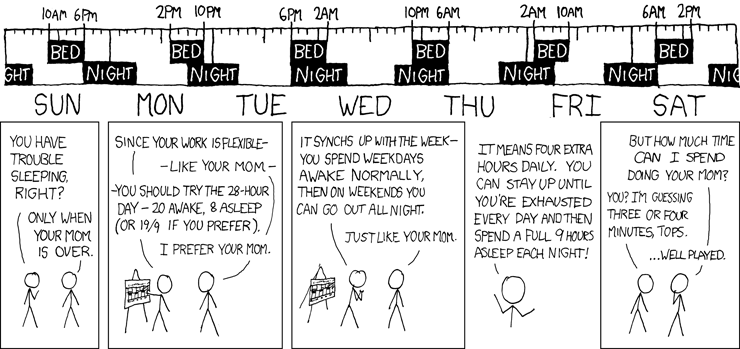
I loved the sound of it, and it even seemed fairly practical, but I figured it would result in confusion  and disconnect from the real world.

I continued exploring and found polyphasic sleeping. I found a 'popular' form was being awake for four hours and sleeping for 30 minutes, reducing the sleep needed per day and increasing productivity. Not only would this be impractical in so many ways (workplace, uni, socialisation etc) but I am the type of person that takes a lengthy time to fall asleep. If tired enough, I can sleep easily, but I am entirely unwilling to try such a drastic measure.

Biphasic sleep fell into my lap recently and quite unexpectedly. I stopped my research on sleep patterns a year ago and had all-but forgotten my findings. After an afternoon of research, it makes sense. Basically, the idea is that you sleep for three hours (for the super-dedicated), 4.5 hours (for most), or six hours (for others) in the morning. Notice that each number is a derivative of 90 minutes? The average sleep cycle is roughly 90minutes long, though people vary from 60 to 120 minutes. You then get up and go about your day. At some point you have a nap for around 90 minutes (another sleep cycle) and continue your day. The idea is that you can have your cake and eat it too; getting up early does not mean sacrificing late nights! Furthermore, you get more time in your day!

I plan to try 4.5 hours with a 90minute nap as I'm not a huge sleeper. While I'm not starting for a few weeks, my planned sleep pattern will be:
1:00am - 5:30am Sleep
6:00pm - 7:30pm Nap
In an ideal world, my nap would be around 3pm, and most likely will be where my uni classes allow, but reality dictates that it be later on. On two days of the week I will be rushing home from class to nap, hopefully getting it in immediately.

A large part of why I am interested to try this is that many people who have trialled such a sleep pattern have found they are more productive and have more energy. I have heard in the past (though I don't have any references to support this) that it is possible that we get too much sleep. I believe that this is probably very likely, based on the largely sedentary nature of the 21st century. We eat much more than we should for the energy we expend and it only makes sense that we sleep too much as well. It's also cited in many places that sleep is important for learning, so I am interested to see if having a nap in the afternoon helps with the learning process.

While there is plenty of scientific information out there, I think the main reason I am interested in biphasic sleep is that I'm a night owl and love staying up late, but see the practical benefits of being an early riser. I love knowing that few people are still awake and the imagery of writing or reading late into the night. For years as a child I woke up at 3:30am (and then more like 5:30am as I worked out I could stay up 'late') and loved having my day underway early. I love going to the gym in the morning, but don't like waiting until the traffic dies down. While I don't need to be anywhere early, I like to be, but late nights aren't something that I am sure I want to sacrifice.


Unfortunately, many of the people I have found online who have documented their biphasic sleep patterns seem to have reverted to monophasic sleeping after either a short period or an extended period. I know that it probably is not practical in the long term, but I can see the value of it for me at this stage of my life. I will be travelling overseas later in the year and know that I woun't be able to continue sleeping in this way, but during semesters, I see the value. At least I can say that I tried it!


Tuesday, March 20, 2012

How soon is too soon to get started on assessment?

If you are a law student, I wouldn't be surprised if your approach to assessment is dissimilar from mine: I have a tendency to get super-motivated and start an assignment the second I receive a topic. That motivation lasts about an hour, often less, as I realise the topic is boring/difficult/easy/stupid. At some point (often a week or so before it is due, although sometimes in the days before) I become super motivated yet again. This all ends up with me handing in an assignment that I am totally sick of and, a week later, would not be able to tell a person the topic.

We all know it isn't the best way to go about getting a lousy few marks down before our big exams, but we all do it anyway. We all wonder if it was the adrenaline, Red Bull, coffee or lollies that kept us going and vow to ourselves that it will not happen again as we drift off to sleep, still standing in front of the submission box. Other students behind us growing impatient, we promptly forget the promise we made to ourselves and carry on, destined to forever forget to start the next assignment early.

When I start an assignment, or even studying for that matter, early enough, I have a tendency to assume it is too early and 'no one could possibly be starting now'. WRONG! Someone else always will have started before you and law school is WAR. Well, not really, but you get the idea! Do you really want to be the last person to start? Even factoring the stress of starting an assignment with so little time remaining, neglecting to start in a timely fashion means you run the risk of losing valuable resources, if you are like me and like using library books.

So starting early is a given, right? But what do you do when you are in a situation like I am now, with 3 assignments and 1 exam in a short period of time? Someone told me in high school that when you get an exam timetable you should always plan to start studying for the last exam first.  It sounds counter-intuitive, but it makes plenty of sense. I'm planning on taking this idea and using it for my assignments. While I won't completely finish the one due last now, I plan to have a great draft done in the next week or so which will enable me to spend the time I need to spend on my other pieces of assessment.

What is your take? Do you start super early or are you like me, a perpetual procrastinator?

Monday, March 19, 2012

Here we go again....

So the moment I have been dreading has finally come. Life got hectic! 


After a super busy week of uni and trying to catch up on readings (a result of my decision to do my readings after classes... still fine tuning the system) I decided to take a look at the assigned topics for assessment. Did I mention I was so busy I didn't notice essay topics for one of my subjects were released for almost a week? On top of that I almost forgot about my external subject yet again. It seems my rather strict study schedule is not strict enough... or maybe too strict.

Sunday, March 11, 2012

ALL I DO IS READ!

AHH law school! I seriously think all I ever do is read! Read this, read that!

I generally have a fairly strict rule about finishing the assigned readings before a class. I tend to feel that if I do not do the readings first I will not do them. Of course, this works negatively because if I haven't done the readings I have previously felt that the class would not be of any benefit. Obviously this isn't a good way to go! In my first year I varied between reading before and after and I felt that before worked better for me.

 I've changed this policy this year, at least for my Medical law subject. While the lecturer may have a general plan as to where he will finish each lecture each week, the course is divided into seven general topics. It has taken two weeks thus far to complete the first topic and I almost gave myself a heart attack looking at the learning guide and seeing how much reading was expected for that first week. Needless to say I was unable to complete the hundreds of pages and was relieved to see that we only completed a third or so of the topic. I then decided it was probably more beneficial to do the readings after the class so I would know how far to go.

This week I extended the reading after lectures idea to all classes. It wasn't intentional as I had family commitments over the weekend that prevented me from doing all preparation over the weekend. I learnt that a real benefit of reading after you have been to class is that anything a lecturer emphasises is going to be something you pay more attention to. If you are reading prior to class you just have to assume everything is important. Sometimes a lecturer disagrees with the text they have assigned on important points and taking the text as gospel is useless. Of course, lecturers sometimes go the other way and don't emphasis parts of the textbook but expect you have paid attention to them in your readings when it comes to the final exam.

So what did I learn? I learnt that it is definitely the way to go for subject where how much content will be covered is not known, like my medical law subject. It is also a good way to go when the lecturer may have a different perspective to the text. Reading, or at least perusing the text, is better for more difficult subjects. For me, Trusts is more difficult and very heavy. It isn't helped that the class does not finish until 8pm and I have a busy day. When it gets to my trusts lecture, I'm exhausted, both physically and mentally so I struggle to actually absorb the information if it is 100% new. For this subject, I really have to be familiar with the content before I get to class.

What is your approach? Do you do your readings before or after class? Do you vary your approach based on the subject itself? I'm interested to see what others do!

Tuesday, February 28, 2012

TEA-LOVING!

So regular readers may remember that I have just moved into a house off-campus. It is a rather big adjustment, what with cooking and cleaning, not to mention adjusting to the idea of a commute to classes. As you can imagine, it's quite a bit to get used to. Of course a new house brings new habits!

I've written previously about my love of coffee but I've recently begun to appreciate the value of a nice cup of tea. I had never drunk tea until a few months ago when I was told green tea would have some great health benefits. I promptly went to one of those chain stores that sell looseleaf tea and infusers and bought a few varieties.

I didn't really enjoy the tea too much and figured it was just something I would have to adjust to over time. While travelling I was served peppermint tea as an alternative to the amazing smelling hot chocolate others had. I drank it and found I rather liked it.

With a return to studies, I assumed that I would also return to my coffee drinking habits although I am unable to find my coffee plunger. I did however find my stash of herbal teas that I grabbed one night while I lived on campus planning to try them eventually. On a stormy night last week I was cool and decided a tea would be lovely. There is a first for everything!

So here I am, loving tea. I'm sure as the assessment begins to pile up I will find my coffee plunger and coffee will once again reign supreme.